
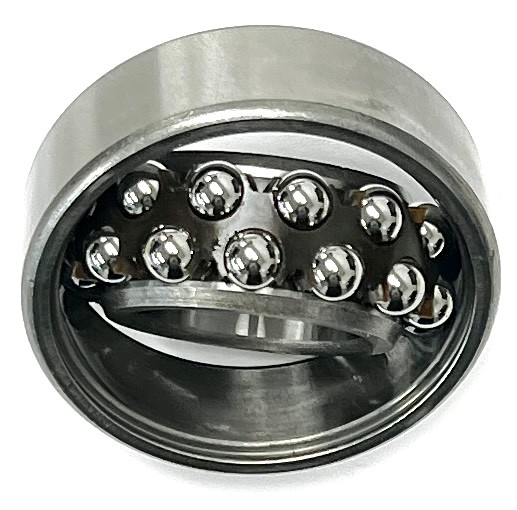
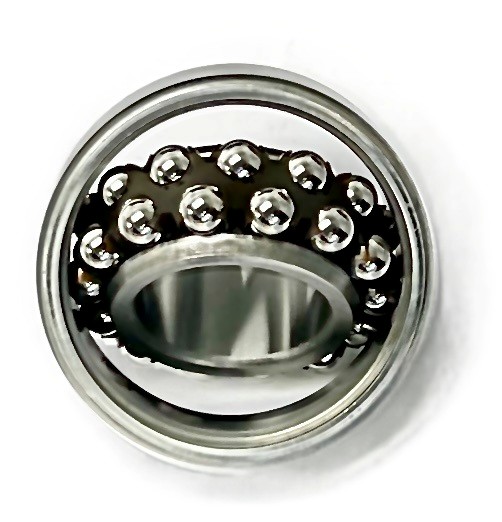
Self-aligning ball bearings feature two rows of balls and a common, continuous spherical (concave) raceway in the outer ring. This spherical outer ring raceway allows the inner ring, with its two raceways, balls, and cage assembly, to swivel or rotate freely around the bearing center within certain limits. The primary function is to permit angular adjustment without generating excessive friction or heat, which would otherwise reduce the bearing's service life, they can typically accommodate static and dynamic angular misalignments of up to 3 to 4 degrees, depending on the specific design.
These bearings are well-suited for high radial loads but have a relatively low axial (thrust) load capacity due to their small contact angle.


